Loving my neighbour and those six passages

Christian discussions on same sex relationships eventually come back to an infamous six passages in the Bible – often known as the “clobber texts” – which are traditionally deemed to be negative or prohibitive towards all same sex relationships. Indeed, for Evangelical Christians with a particular view on scriptural authority, these are ultimately the only texts that matter: they are there, this is where the Bible discusses the issue, they are clearly negative: end of argument. I could imagine such Christians being disappointed with the Living in Love and Faith 5-session course, that it does not give sufficient prominence to these texts – they are mentioned in week 4, but in very full course there is not time given over to detailed study. A much fuller discussion is found in Chapter 13 of the LLF book, which sets out some of the different ways these potentially tricky passages might be read. It emphasises, rightly, that these passages must not be read in isolation, but as part of the broader Biblical narrative. LLF deliberately takes this approach in its ordering of the material, also first bringing in the witness of society, science and the wider church. Likewise, I have written a good number of blog posts on this topic before (in this post) looking at the six passages. In the end, though, we do need to come to a view on what these passages are saying. This is especially true if we are to have any hope of convincing anyone from a certain section of the Christian community (if such hope exists at all).

I’m going to take an approach which, though I doubt it is original, is one that has been steadily growing in my mind as a potentially fruitful approach. I’m going to try to read these six passages through the window of another Bible passage, where Jesus is asked about the greatest commandment. Jesus gives his top two!

‘“Love the Lord your God with all your heart and with all your soul and with all your mind.” This is the first and greatest commandment. And the second is like it: “Love your neighbour as yourself.” All the Law and the Prophets hang on these two commandments.’

Matthew 22:37-40 (NIV)

I am struck particularly by the phrase “All the Law and the Prophets hang on these two commandments.” What Jesus seems to be saying is that if you start with just these two commandments, and think it through, then you can pretty much infer all the rest. Stick with these two commands, and you will not go far wrong. I struggle to think of any ethical teaching in the New Testament that is not in some way covered by these two commandments. Moreover, “Love your neighbour as yourself” seems to be a general principle that goes well beyond Christian ethics. Secular ethical theories, from Kant to Hobbes, seems to be attempts to formulate a rational way to work out what “Love your neighbour as yourself” means in practice (a sort of “but who is my neighbour?” kind of question). [By the way, I really very much like these Crash Course Philosophy videos on ethics].

So, I think it is not an unreasonable question to ask of the six “clobber passages”: in what ways do these reflect the command to “Love your neighbour as yourself”? Is there a way of reading them in the light of this command? Is the traditional reading consistent with it? Do these passages break the general rule that everything hangs on these two commandments? If we read these passages in a way that is not loving our neighbour as ourselves, then what are we doing? I’ll offer a few thoughts on each passage.

Leviticus 18:22 and Leviticus 20:13

Were these outright bans on sexual relations between men? I think it is likely that they were, at least in the time and context they were written. Here, “loving your neighbour” is exhibited in protecting the life of the community, above all else. Many of the Levitical laws can be viewed as preventing abuses enacted by strong, patriarchal heads of family, or as preventing disruption to community life. There could also be an aspect of community health in these laws – for example many of the food laws require avoiding foods likely to give food poisoning. If I come down with a bout of gastroenteritis through deliberately eating the wrong food, it isn’t very loving to myself, or to my neighbour. Likewise, in an age long before modern medicine, many of the sexual prohibitions in Leviticus could be considered to limit the spread of disease through a closed community.

Overall: the Levitical Laws are not subtle, but they probably needed to be so. They are loving towards the neighbour in that they are designed to protect and nurture the life of a tribal community.

There is a question as to whether these Laws apply today. It is frequently pointed out that there are many Levitical Laws that we now ignore. Various schemes are proposed as to which Laws we keep, and which ones we are allowed to throw out (e.g. suggesting that there are a set of “moral” Laws which we keep). A more radical suggestion, which I am wondering might be better, is to say that with Jesus the purpose of the Law was fulfilled. That part of the Biblical story is over: so, the Old Testament Law no longer applies…. none of it! Instead, through the Spirit, the “Law” is written on our hearts, and the Spirit guides us decide on what is the right course of action. In Galatians 5:19, Paul says that sinful acts are “obvious.” We are called to think it through, on the basis of (for example) principles such as loving your neighbour as yourself. The result is often similar to the Old Testament Law, but being able to think for ourselves helps us to behave naturally in a virtuous way, rather than checking the back to a written law to decide every action.

Genesis 19

On this passage, I will be very brief. The real sin of Sodom was in that they failed to treat their neighbours well. When strangers and outsiders visited, they failed to offer welcome, but instead offered threats and abuse. It is not a pleasant story.

1 Corinthians 6:9-11 and 1 Timothy 1:8-11

These two passages each list a number of types of people, who habitually do certain things, who are sinful and contrary to the kingdom of God. In the 1 Corinthians passage, a pair of Greek words are used: malakoi and arsenokoitai, which are traditionally taken to encompass all (male) homosexual behaviour; the second of these words is repeated in the 1 Timothy list. It needs to be pointed out that all translations and interpretations of these two words are tenuous: the first is a Greek word meaning “soft”, and the second is a word that was made up by Paul. We can’t simply look these words up in a dictionary of Ancient Greek and translate their meaning with unerring confidence. It is not unreasonable to dispute the meaning of these words, and many people do.

Yet, it seems to me that the “window” of Matthew 22:37-40 is a helpful one here. For when we look at the other “sins” on the lists – sexual immorality (unfaithfulness or promiscuity), adultery, thieving, excessive drunkenness, slander, greed, swindling, murder, slave-trading, perjury, lying – it is easy to make the case for every one of these that they are not “loving my neighbour as myself”. They are also obviously wrong, in the language of Galatians 5:19. [The only exception in the list is idolatry, and that breaks the first commandment in Matthew 22:37-40]. So, it seems to me that, however we translate malakoi and arsenokoitai, these must also be things that are not “loving my neighbour as myself”.

Clearly this would favour interpretations that limit these translations to instances of homosexual behaviour that are abusive, or promiscuous, or harmful in some way to the self. But, I think I would turn the question on its head at this point: in what way is a loving, faithful, publicly committed same-sex relationship contrary to “loving my neighbour as myself”? If it is not contrary to this principle, then I do not believe that such a relationship is ruled out by these verses.

Romans 1:21-32

It is worth considering the overall logic of this passage. Paul’s argument is first that humans rejected God: “they neither glorified him as God nor gave thanks to him” (v21); they “exchanged the glory of the immortal God for images” (v23); they “exchanged the truth about God for a lie, and worshipped and served created things” (v25); “they did not think it worth while to retain the knowledge of God” (v28). As a result, God “gave them over” to many sinful things that harm themselves and harm others: “to sexual impurity for the degrading of their bodies with one another” (v24); “to shameful lusts” (v26); “to a depraved mind, so that they do what ought not to be done” (v28) so that “they have become filled with every kind of wickedness” (v29).

In other words, echoing Matthew 22:37-40, humans broke the greatest commandment: they did not “Love the Lord your God with all your heart and with all your soul and with all your mind.” As a result, God gave them over to things which break the second commandment: they did not “Love your neighbour as yourself.” Because of this, they do things which harm themselves, and harm others. This is the shape of Paul’s argument.

And so, in verses 29-31 we find another sin-list, having some overlap with 1 Corinthians and 1 Timothy, but adding envy, strife, deceit, malice, gossip, insolence, arrogance, boastfulness, and lack of love, fidelity or mercy. We now have, by my count, 22 different sinful behaviours (excluding the same sex relationship ones) listed in these three short New Testament passages, and every single one is both (i) not “loving your neighbour as yourself” and (ii) obviously wrong, in the sense of Galatians 5:19.

Yet, Romans 1 is different, in that Paul spends two whole verses (26-27) focussing on some forms of same-sex behaviour. It is, if you like, Exhibit A in his argument, and he dwells on it. But this, if anything, strengthens the case I am trying to make. Here, whatever Paul is referring to in verses 26-27, he is not trying to teach that it is wrong. That is, he isn’t trying to convince his readers or listeners that something they otherwise thought was OK is in fact wrong. Instead, within the rhetoric of the passage as a whole, Paul is relying for the force of his argument that his readers will already know in their bones that the thing he is describing is clearly and obviously wrong. His argument is that “humans turned away from God, and so look, now they even do this.” Paul needs his readers to agree immediately that “this” is wrong for his rhetoric to work.

So, even if we blanked out verses 26-27, and did not know what kind of sinful thing was being described, we would know already that it was both obviously wrong, and highly likely to be in the category of not loving your neighbour as yourself. The surrounding context and the shape of Paul’s argument in the surrounding verses demand that it must be so.

Can we give an interpretation of these verses that satisfies these requirements? I believe so, because Paul talks here about a process of deliberate “abandoning” or “exchange”, and of being “inflamed with lust.” Much depends, of course, on how you understand the “natural” relations which are being abandoned. But, here, I think we have to listen to the testimony of countless same-sex attracted Christians. When they desire a loving, faithful, publicly committed, exclusive relationship with a same-sex partner, they do not in any sense feel they are abandoning or exchanging anything; they are not being inflamed with lust; they are not acting against the rule of “loving your neighbour as yourself.” Whatever it is that these verses speak against, it is not the thing that they desire.

But what if, in ancient Rome (or anywhere else), people were to seek out sexual gratification by any means? What if, despite a natural opposite-sex attraction, they were to seek out means of titillation, of indulging themselves? We know that such opportunities were abundantly present then (even as they are today). Many temple-cults and religions included sexual practices of all kinds. Paul would not have had to look far beyond his door to find practices that both he, and his readers, would recognise very well. Look here, he might say, this is what humans do; look at how they abandon what is natural to them; look at how harmful it is both to them and those connected with them. Clearly they are neither loving to themselves, nor loving to their neighbour, if only they could understand what love really is.

Summary

Well, this post took longer to write than I intended, and I guess is quite long to read too (sorry). I hope that you find that Matthew 22:37-40 is indeed helpful as a means to think about these passages. To my mind, we can either choose to read these passages as being consistent with “loving our neighbour as ourselves”, or we can choose not to. To me, what we call “sin” should be obviously against loving our neighbour, in the same sense that the 22 other sins listed in the three New Testament passages above are obviously so. If we choose otherwise, we shouldn’t be at all surprised if the watching world cries “injustice!”

The joy of jogging (and Coakley part 3)

In the last month and a half, I’ve started running to get fit again. This is a big deal for me: I am not a natural “runner” and until now I’ve avoided jogging as a form of exercise. As a teenager at school I always excelled in the short sprints, and especially the jumps: a brief and sudden release of energy worked well for me. But I would detest anything beyond 100m, and especially loathed cross-country. In adult life I’ve managed to stay reasonably fit, but I much prefer the joy of competition and sport to drive me on: this in itself is revealing about me – competitiveness motivates me where all else fails.

Still, after a coronavirus winter in which my usual exercise was not available, and in which I put on a bit more weight than I’d have hoped, I concluded that I was getting out of shape and something needed to be done. So, somewhat reluctantly, I bought a pair of suitable trainers and decided to have a go. And, steadily, I’ve built up from not being able to run very far before needing to rest, to being able to run a fair amount further. Most recently, I managed a steady jog of around 4km… I am not sure I ever did that before in my life.

There is one thing I have discovered (I am sure all you joggers out there already knew this but somehow it had eluded me). In my prior running, of sprints and dashing around a football field, there would be a short injection of energy, a quick dash, and the thing that would stop me running any further would be that I got out of breath: I guess a running out of oxygen to keep things going. But I now discover this: there is a pace I can run at – for me a slow plod – where it seems I can just keep going, on and on, at a steady pace, and never get out of breath. In the end, what stops me is fatigue. Legs that are not used to this kind of treatment eventually give up! But, at the slow plod, I reckon my lungs could go on for as long as needed. Maybe after a bit more practice my legs will be able to keep going as well.

Well, of course. I mean, how else would you run a marathon except to find a pace you are comfortable with and keep at that pace?

I am sure that I don’t make it look this good.
Photo by Pixabay on Pexels.com

Metaphors about running are not uncommon in Christian writing: the Christian life is often likened to a race. I’ve often thought about how we run that race. Is it like my former running self, a series of short sprints, a few heady leaps, spurred on by competition, but followed by a breathless collapse? There is a tendency towards a sort of up-and-down Christianity: searching for the next big experience – the high of a Christian summer conference, for example, or the constant searching for what urgent thing the Spirit might be saying to us. Lord, do something, do it now. But, it is difficult to maintain a constant high. Is there, perhaps, merit in the slow and steady plod, in attention to God within the mundane?

In The New Asceticism: Sexuality, Gender and the Quest for God Sarah Coakley draws our attention to the life of W.H. Vanstone (or just plain Bill Vanstone). He was intelllectually brilliant. Yet, after a superb undergraduate and graduate career he eschewed the (often repeated) offers of attractive academic positions, and instead chose to spend the better part of his life as a priest in a suburban housing-estate parish in Rochdale. He struggled through the process of tending to the life of his parish: baptising, marrying, burying, preaching and breaking bread on Sundays. Often he would walk the streets of his parish simply meeting and talking to people. It was often difficult, and did not always obviously result in much fruit. It was a slow, and steady “practice” of the Christian ministry. But, towards the end of his career and life, he published three short books: Love’s Endeavour, Love’s Expense; The Stature of Waiting; and, shortly before his death, Farewell in Christ. The first of these – now sitting, waiting to be read, on my table, is based on his work on the housing estate, with its difficulties and occasional unexpected highpoints; it is about the costliness of love. The second book (I am presently half way through the Kindle edition) is about the passion and “handing over” of Christ, and about how we can identify with Him in our periods of waiting (as opposed to our tendency to glorify constant activity and achievement). These books are thoughtful gems, condensed from a lifetime of patient ministry; it may not have been possible to write them without the prior slow and steady practice.

Infamously, Vanstone likened the church (particularly the C of E) to “to a swimming pool in which all the noise comes from the shallow end”. I kind of know what he meant. With the current debates and divisions, I feel like we kind of need a bit of insight from the deep end right now.

The wider context of this particular chapter in Coakley’s book is about different stages of Christian “practice” or “discipline,” and on how these relate to the formation of belief and insight. In the earliest stage, the initial belief and commitment gives rise to a potentially strict discipline. The young Christian might need firm rules and guidelines, a list of dos and do nots, if you like. There may be need to make a clear distinction or break from a former way of life. So, there is perhaps a tendency to overemphasise and legalise the rules.

Coakley likens a second stage to the life of the Benedictine monastry, where simple and repetitive tasks (psalm-singing, harvesting, building, welcoming strangers, etc.) contribute to the community life. It is no longer so much about keeping the rest of the world out so as to stay clear of the former way of life. Instead, it concerns the development of habits of love, virtue, servanthood, of making the Christian life “natural” to us. It is about finding Christ in the everyday and mundane, and in those around us, and so becoming ourselves more Christlike (not in a strict moral sense but rather in our characteristic behaviour). At this stage, practice starts to reshape belief. This, I think, is the slow, steady, jog of the Christian life.

Coakley postulates a final stage, related to the deep prayer and contemplation of God alluded to in my previous post: the rare type of prayer described in Romans 8 that might give rise to a fully Trinitarian experience and understanding of God. Here, the practice of prayer has the potential to reform and reshape our belief in a deep way. I cannot say for sure that I have ever found such a place of pure prayer! Yet, Coakley is realistic. She is quick to emphasise that there are very blurred lines between these three stages of practice, and that one certainly does not leave the earlier stages fully behind. Finally, she notes that even if such a final stage is attained there is no sense that it can be counted on to endure!

Trinity, Desire, Aesceticism: two Sarah Coakley books (part 2)

I’ve been looking at a couple of Sarah Coakley books during Lent: The New Asceticism: Sexuality, Gender and the Quest for God, and her earlier book God, Sexuality and the Self: An essay ‘On the Trinity’. In part one of this not-quite-a-review, I discussed a few themes that had struck me and stayed with me for a good time after reading the books. I am interested in her discussion of a theology of desire, and how we might align our desires with God’s desires. In this post I’ll focus on what I recall of her thoughts about the Trinity – these are interesting in themselves. But if Coakley is correct, our relationship with God as Trinity both shapes our views on desire and relationships, and is the means by which our desires are brought into alignment with God’s desires.

Romans 8 as a model of Trinitarian experience

One of the questions Coakley addresses is “Why Three?” – how did the early church arrive at a Trinitarian view of God, and how do we, ourselves, experience God as Trinity? She proposes Romans 8 (one of my favouritest chapters!) as a particularly good model of this experience:

For those who are led by the Spirit of God are the children of God. The Spirit you received does not make you slaves, so that you live in fear again; rather, the Spirit you received brought about your adoption to sonship. And by him we cry, ‘Abba, Father.’ The Spirit himself testifies with our spirit that we are God’s children. Now if we are children, then we are heirs – heirs of God and co-heirs with Christ, if indeed we share in his sufferings in order that we may also share in his glory….In the same way, the Spirit helps us in our weakness. We do not know what we ought to pray for, but the Spirit himself intercedes for us through wordless groans. And he who searches our hearts knows the mind of the Spirit, because the Spirit intercedes for God’s people in accordance with the will of God.

Romans 8:14-17, 26-27 (NIV)

Coakley’s view is that when we pray – especially when we pray in that particularly wordless way – we experience God as Trinity. It is not that we experience God as three distinct and separate beings, as though each is fully distinguishable. But rather, we find that it is God who is praying in and through us, but also God who is receiving that prayer, and also inviting us “into Christ”, into our own adoption as children, sharing in Christ’s sufferings but also in the glory of his resurrection life. And in this experience, each “person” of the Trinity points to, and relates to, the other two. (Coakley is quick to point out that not all our prayers feel like this… such heightened awareness is rare!). It is notable that this experience is “Spirit first”… it is the Spirit who draws us in to these Divine relationships.

Coakley contrasts this with the perhaps more hierarchical, linear and sequential view of Father/Son/Spirit. Of course, as good Trinitarian Christians we are quick to point out that of course all three persons are equal, and equally God. Yet in our speaking and in our singing and (I suspect) in our thoughts we quickly snap back into a hierarchical view. The creeds have… one God, the Father Almighty, the creator… the Son of God, begotten of the Father… and the Spirit who proceeds from the Father and the Son. Any number of songs and hymns follow this pattern. We think of them sequentially: in the Old Testament it was God the Father, then came Jesus, then after that the Spirit.

Yet, there are dangers if we think hierarchically, in a purely linear model… the Father first, then Son, then Spirit; Christ – represtented by the (male?) priest – over the church; men over women; masters over slaves. It is perhaps easy to see how a hierarchical, ordered organisation might (subconsciously?) prefer a linear model of the Trinity.

Coakley’s further theory is that the Romans 8 path to the Trinity was known in the early days of the church, but proved “too hot to handle,” both in that it subverted hierarchy, but also because of other dangers. Romans 8 requires our desire for God to drive us towards a certain loss of control and submission as we allow the Spirit to draw us into the life of the Trinity. In writings on the topic during the early centuries, warnings are given of the potential for confusion and loss of control in other areas of desire… so that only the most experienced and mature, and least prone to temptation might be advised to pray in this manner. For these reasons, speculates Coakley, other Trinitarian models are more dominant and approved in the early “official” accounts. Yet, such issues perhaps should not be ignored or repressed if we are to confront current questions of desire and faith: there is potential for rich insight here.

Trinitarian iconography and “hunt the pigeon”

In Chapter 5 of God, Sexuality and the Self: An essay ‘On the Trinity’, Coakley takes us on a brief guided tour of Trinitarian iconography. Here are some of the images that jumped out at me. The last four, in particular, are worthy of longer pondering. I’ve added a few thoughts to each image, but it’s best just to look at them and think.

The central scene in “Throne of Grace” is an example of what Coakley calls “hunt the pigeon”… where is the Spirit? If you look really closely you can see the dove in the circle above the cross. But the scene is dominated by the stern Father and suffering Son… something that happens very easily when we focus on the cross. (Question: have I ever seen a fully Trinitarian theory of the cross and atonement? Is the idea of the Father separating himself from the Son really Trinitarian at all? And, where is the Spirit in the moment of the cross?)

Divine Fatherhood: this appears to be the usual very hierarchical image, with patriarchal Father and Son. But… what is nice here is that the eye is drawn to the Spirit in the centre… is this a way in to the Trinity?

Divine fatherhood, School of Novogrod, 14th Century
from http://webhome.auburn.edu/~mitrege/russian/icons/divine-fatherhood.jpg

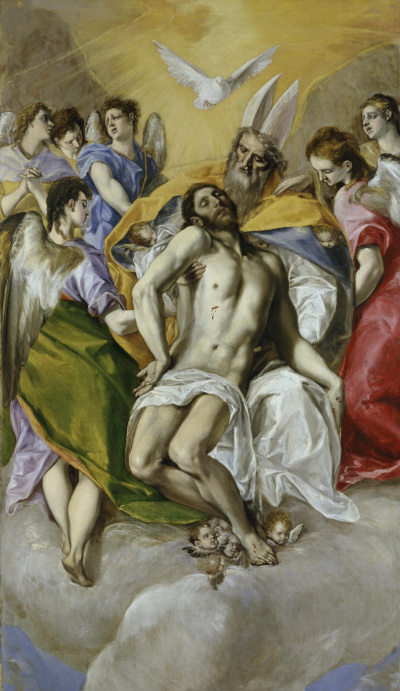
El Greco’s Trinity: has a very symathetic Father figure… but with the focus on the suffering Christ, the Spirit is somewhat separate and peripheral. Perhaps the Spirit is riding to the rescue for the resurrection, but not really involved in the suffering here?

Here is the very famous Rublev Trinity, based on the three figures from Genesis 18. The eye is drawn from one to the next, to the next. And is there welcome, a space at the table for us?

Angelsatmamre-trinity-rublev-1410.jpg
The Trinity, Andrei Rublev, 1411
from https://en.wikipedia.org/wiki/Trinity_(Andrei_Rublev)

This beautiful sketch from William Blake solves many of the problems of the El Greco Trinity. Here the cruciform Son throws himself, face-first, into the Father’s embrace, a leap from death to life; the Father, head bowed is fully involved in the suffering; the Spirit’s broad and enveloping wings match the Son’s outspread arms.

Hildegard’s Trinity is more abstract: the Christ figure (perhaps more gender neutral than intended?) welcomes us in and relates to us, through the surrounding bronze circles of the Spirit and the outer bright circles of the Father.

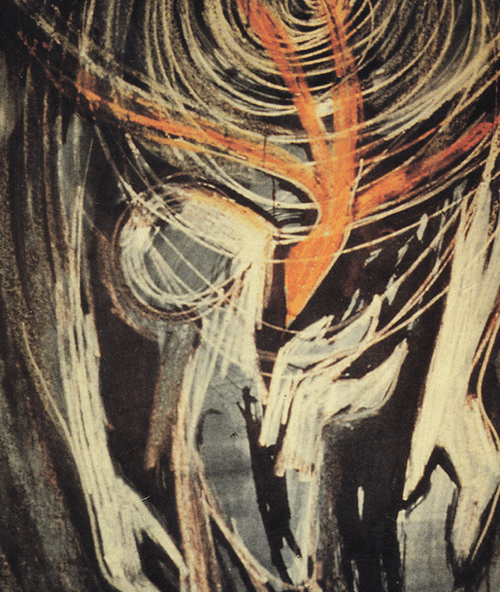
Finally a pastel sketch by Marlene Scholz. Here the Christ figure is also us: we identify with the central figure in deep prayer. The Spirit reaches to us and prays through us, drawing us up to the arms of the Father, and into the circling vortex (?) of Trinitarian relationship. There are clear echoes of the prayer life of Romans 8.

‘Blessed Trinity’, Marlene Scholz, late 20th Century
from https://s3.amazonaws.com/dfc_attachments/public/documents/3257522/1421629466399.png

Reflections on “Jesus’ teaching on marriage”

In session 3 of the Living in Love and Faith course, we are invited to reflect on Matthew 19:1-12. According to the course booklet, this (together with a similar passage in Mark 10) gives the fullest account of Jesus’ teaching on marriage. Let’s take a look, particularly at verses 3-6:

Some Pharisees came to him to test him. They asked, ‘Is it lawful for a man to divorce his wife for any and every reason?’

‘Haven’t you read,’ he replied, ‘that at the beginning the Creator “made them male and female,” and said, “For this reason a man will leave his father and mother and be united to his wife, and the two will become one flesh”? So they are no longer two, but one flesh. Therefore what God has joined together, let no one separate.’

Matthew 19:3-6 (NIV)
https://i0.wp.com/www.jesuswalk.com/manifesto/images/bloch-sermon-on-the-mount815x912.jpg

A traditional reading of this passage would say something along the following lines. This is where Jesus gives his fullest teaching on marriage. He goes back to the creation accounts, and sets marriage in that context. In particular, he emphasises that marriage must be “male and female”. So, there you have it – Jesus supports the view that marriage is between a man and a woman. (I admit this is a brief caricature of a traditional reading, rather than a full exposition).

Yet, this is not what struck me when I reflected on the reading, and I wanted to offer some alternative thoughts.

Firstly: the context. I am not sure it is correct to describe this as “Jesus’ teaching on marriage”. It is not the case that the disciples sat Jesus down and said, right, tell us everything you would want to say about marriage. Instead, the context of the passage is a (potentially) tricky question about divorce: ‘Is it lawful for a man to divorce his wife for any and every reason?’ It would be more accurate to describe this as Jesus’ teaching about divorce. A good rule of Bible study is that we should always pay attention to the context, because this gives the primary meaning of the passage.

Secondly: the question itself. At least to my eyes, there are two objectionable aspects to the question the Pharisees asked. ‘Is it lawful for a man to divorce his wife?‘ I take note of the unequal nature of this: men divorce women, not the other way around. ‘For any and every reason?‘ What strikes me here is the unfaithfulness and injustice of it. It does not need to be a good reason, any reason will do. The question implies a casual disregard both for the marriage contract and for the essential humanity of the woman involved. Divorce along these lines would leave the woman destitute, and likely cut off from her community. So, the question asked by the Pharisees emphasises both inequality and unfaithfulness. It seems to me that Jesus’ answer, and the Bible passages he cites, are a perfect riposte to these two aspects of the question.

Let’s take a look at the answer. So, yes, clearly God “made them male and female”. But, in the context of his answer to the Pharisees, there was no particular sense in which Jesus needed to emphasise the male:female aspect of marriage. Their question presupposed it (‘Is it lawful for a man to divorce his wife?‘). And, the wider cultural context presupposed that marriages were male:female. In short, no-one here was asking the question ‘Is marriage only for male and female?’; correspondingly, Jesus is not answering that question. In short:
Pharisees: Is it lawful for a man to divorce his wife?
Jesus: First let me emphasise that marriage must be between a man and a woman.
Pharisees: ??
It should be clear that this does not make sense!

The danger for us is that we are bringing a burning question to the passage from our own context: “Is marriage only for male and female?” So, seeing that Jesus uses the words “male and female” we assume that Jesus is answering our burning question. But, we should not assume that the passage is here to answer our questions. If we do this sort of thing, we should be aware that in allowing our question to dominate the reading, we distort the passage and might possibly be missing the very thing that Jesus is trying to say.

The first passage to which Jesus refers is from the first chapter of Genesis. When Jesus quotes from the Old Testament, it is often the case that he has the whole passage in mind, and not just the specific words he quotes. It is frequently informative to look at the whole verse or passage: an example of this principle is the two verses Jesus gives to explain his clearing of the Temple (I have written a blog post on that from some years ago). In the present case, the verse Jesus refers to is:

So God created mankind in his own image,
in the image of God he created them;
male and female he created them.

Genesis 1:27 (NIV)

Here, we find the key phrase “in the image of God he created them/ male and female he created them“. Both male and female are created in the image of God: there is a deep sense of equality here, which I think is a perfect answer to the inequality implied by the Pharisees’ question. What Jesus seems to be saying is, “This woman you (men) are proposing to divorce – she is made in God’s image as well. She is profoundly equal to you, and profoundly loved by God. How dare you presume to hold that power over her, such that you can divorce her for any reason you choose?”

The second quote (from the separate, alternative creation story in Genesis 2) is more transparent, and I think most would agree that Jesus is emphasising the faithful and (in principle) unbreakable contract of marriage: “a man will leave his father and mother and be united to his wife, and the two will become one flesh… So they are no longer two, but one flesh.” Here, it seems to me that Jesus’ primary intention is clear, and the discussion later in the passage confirms it. You Pharisees say that “any reason” will do, but you are being unfaithful to your wife, and (also) unfaithful to God.

In summary: the Pharisees’ question implied inequality and unfaithfulness. Jesus’ carefully crafted answer, in return, emphasises both equality and faithfulness.

Design a site like this with WordPress.com
Get started